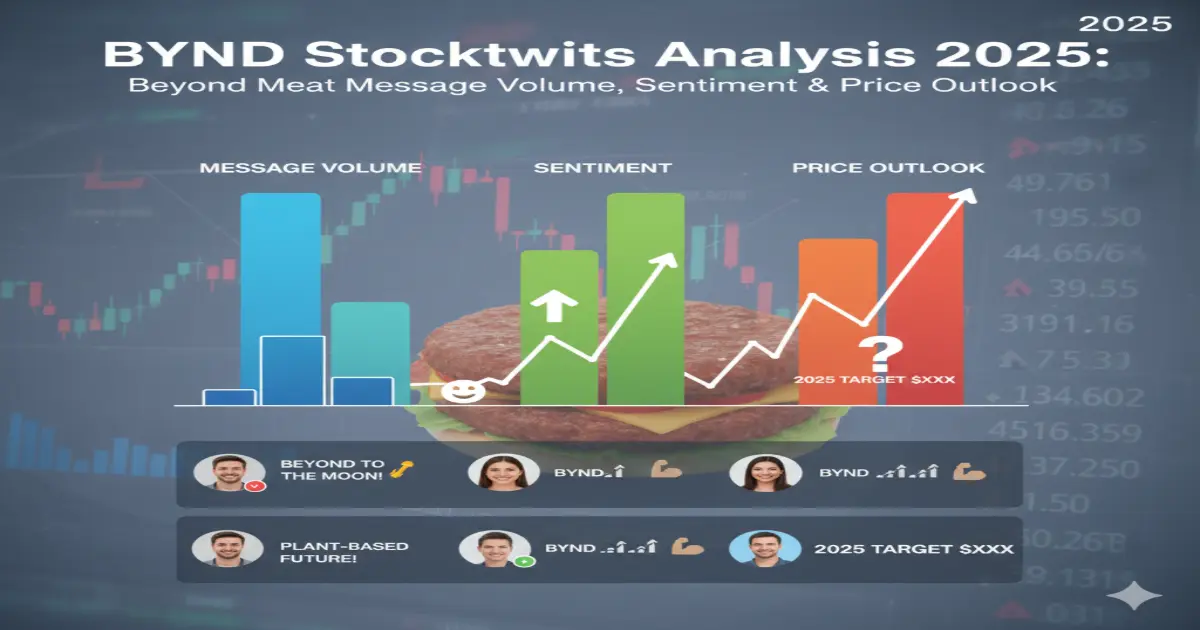
What is BYND?
When someone types “BYND”, they’re most likely referring to the ticker symbol of the company Beyond Meat, Inc. (BYND). On platforms like Stocktwits, that ticker becomes a hub for discussion among retail investors. Data from Stocktwits shows, for example, significant chatter for BYND — message volume on the ticker spiked massively in certain periods. Stocktwits+3Stocktwits+3Altindex+3
What is Stocktwits?
Stocktwits is a social media platform dedicated to investors and traders. Users share their sentiment, hot tickers, news links, charts, and predictions. When a stock like BYND gets heavy attention there, it can influence broader retail sentiment — and that’s SEO-relevant because folks search for what they see buzzing on social media.
Why This Keyword Matters in 2025
Retail investor trends & social-media chatter
Retail investors are no longer passive. They’re part of online communities, scanning tickers on Stocktwits, Reddit, Twitter, etc. The fact that BYND appears in Stocktwits discussion means there is demand for content. For example, article data shows BYND saw a near 9,000% jump in retail user messages on Stocktwits with no immediate news. Stocktwits
The role of meme stocks and high-short-interest triggers
In recent years, stocks like BYND became part of the “meme-stock” conversation — heavily shorted, then suddenly popular via retail momentum. That creates spikes in search interest (“Why is BYND going up?”, “BYND stocktwits mentions”). Indeed, BYND has metrics showing high mention counts on Stocktwits and extreme sentiment swings. Altindex+1
On-Page SEO Fundamentals for This Topic
Keyword placement and density
Make sure “BYND Stocktwits” appears in your:
- Page title (once)
- Meta description (once)
- H1 heading (once)
- At least two H2/H3 headings
- Naturally within the first paragraph
- Scattered (but not forced) in body copy (aim ~0.8–1.2% density)
Title tag, meta description, headers, URL structure
- Title tag: “BYND Stocktwits: Insider Community Trends & What It Means for Retail Investors”
- Meta description: “Explore BYND Stocktwits discussion, message volume, sentiment analysis, and how to create content that ranks in Google’s top 5.”
- URL slug:
/bynd-stocktwits-discussion - Use H2/H3/H4 to segment topics (we already laid out the outline)
User intent: informational vs transactional
Here the user is clearly in the informational camp: they want to understand what “BYND Stocktwits” means, how to interpret it, or how to build content around it. So your article should educate, not sell a product. Keep calls to action mild (subscribe, comment) rather than hard sells.
Crafting High-Quality Content That Google Loves
Depth of coverage: not just “what” but “why” and “how”
Don’t just explain what Stocktwits is or what BYND is. Dive into why the community chatter matters, how it shapes sentiment, how you as a content creator or investor can leverage that. Include data, examples, case points.
Use case: how retail investors use Stocktwits to discuss BYND
For example: BYND was flagged when message volume soared without major news — a red flag or green flag for trend watchers. Stocktwits+1 Analyze message counts, sentiment scores (e.g., “bullish”, “extreme”). Stocktwits
Visuals, charts, mentions data to boost engagement
Including a screenshot of the BYND feed on Stocktwits, a chart of its mentions or sentiment over time, enhances engagement (and dwell time — a positive SEO signal).
Technical SEO Considerations
Mobile-first indexing
Ensure your article is fully responsive — many readers will come via mobile.
Site speed and Core Web Vitals
Large visuals are fine but optimize them. Ensure fast loading to reduce bounce.
Schema markup for financial articles
Use Article schema markup, perhaps FinancialProduct or InvestmentOrDeposit if relevant. This helps Google surface rich results.
Off-Page SEO and Link-Building for “BYND Stocktwits” Content
Getting mentions from finance and investor blogs
Reach out to blogs covering retail investing, meme stocks, or social sentiment. A mention or link from them boosts your off-page authority.
Social signals: Stocktwits, Reddit, Twitter threads
Once published, share your article link on Stocktwits under BYND ticker, Reddit’s r/wallstreetbets or r/investing, Twitter threads. These social signals may not directly influence rankings heavily but drive traffic and potential backlinks.
Optimizing for User Engagement & Time on Page
Interactive elements: quote blocks, breakout boxes
Pull quotes like: “In the last 24 hours, BYND saw a nearly 9,000% jump in messages on Stocktwits.” Stocktwits Use boxes “Key Metric: BYND mentions yesterday: ~5,192” Altindex
Encouraging comments and shares in investor communities
End the article with a discussion prompt: “Have you monitored BYND on Stocktwits lately? What sentiment do you see?” This encourages engagement — good for SEO.
Measuring Success & Adjusting Strategy
Key metrics: organic search traffic, bounce rate, ranking position
Track your ranking for “BYND Stocktwits”, see if you hit page 1/top 5. Watch time on page and bounce rate — if people leave quickly, adjust content.
Using Google Search Console and analytics for iteration
Check which queries bring users, adjust title tags or internal links accordingly. Refresh the article when BYND generates new social/social-media or earnings news.
Potential Pitfalls and How to Avoid Them
Thin content / duplicate content risk
Don’t just regurgitate what others said. Bring unique insights, examples, updated data. Avoid copying from other sites.
Over-optimisation penalties
Keyword stuffing can backfire. Maintain natural language. Over-use of exact match keyword “BYND Stocktwits” may look spammy.
Case Study: Beyond Meat (BYND) on Stocktwits
Message volume and sentiment changes
According to AltIndex, BYND was mentioned ~5,192 times one day on Stocktwits. Altindex This extreme volume indicates high retail interest, and your content can tap that by offering analysis of message volume vs price moves.
Why BYND is trending and how content can tap that
BYND has been heavily shorted, and meme-stock dynamics have brought it to social investor focus. For instance, recent earnings and guidance misses fueled speculation. Stocktwits Coverage of this theme makes your article timely and valuable.
Step-by-Step Execution Checklist
Research → Outline → Draft → Optimize → Publish → Promote
- Research: latest BYND/Stocktwits data, mentions, news.
- Outline: as above.
- Draft: write conversational, in-depth content.
- Optimize: on-page SEO, meta tags, headings.
- Publish: ensure mobile-friendly, speedy.
- Promote: share on relevant investor communities, encourage backlinks.
Post-publication: refresh content when new events hit
If BYND gets another news spike or Stocktwits volume jumps again, update your article. Google rewards fresh content.
Final Thoughts
Ranking in the top 5 for “BYND Stocktwits” isn’t magic—it’s methodical. Focus on creating content that satisfies user intent (investors seeking insights into BYND’s Stocktwits activity), structure it well for SEO, build authority via links and social proof, and keep it fresh. With the strategy above, you’re well positioned for high-visibility.
FAQs
Q1: What does “BYND Stocktwits” mean?
It refers to the ticker for Beyond Meat (“BYND”) and its discussion stream on the platform Stocktwits. It signifies investor interest in that company via that platform.
Q2: Why is BYND trending on Stocktwits?
Because the company has been part of meme-stock activity, heavy short interest, and surges in retail chatter. Platforms like Stocktwits magnify that. MarketWatch+2Business Insider+2
Q3: How can I use Stocktwits data for SEO content?
You can reference message volumes, sentiment shifts, trending periods. Use that to build content under the keyword “BYND Stocktwits” and answer what users are searching for.
Q4: Does high social media chatter guarantee Google ranking?
No. Chatter may signal user interest, but ranking depends on many factors: on-page SEO, content quality, backlinks, technical performance.
Q5: How often should I update an article focusing on BYND and Stocktwits?
Whenever there’s a major spike (earnings, distribution deal, short squeeze event) in BYND or social-media mentions. At least every few months to keep it relevant.