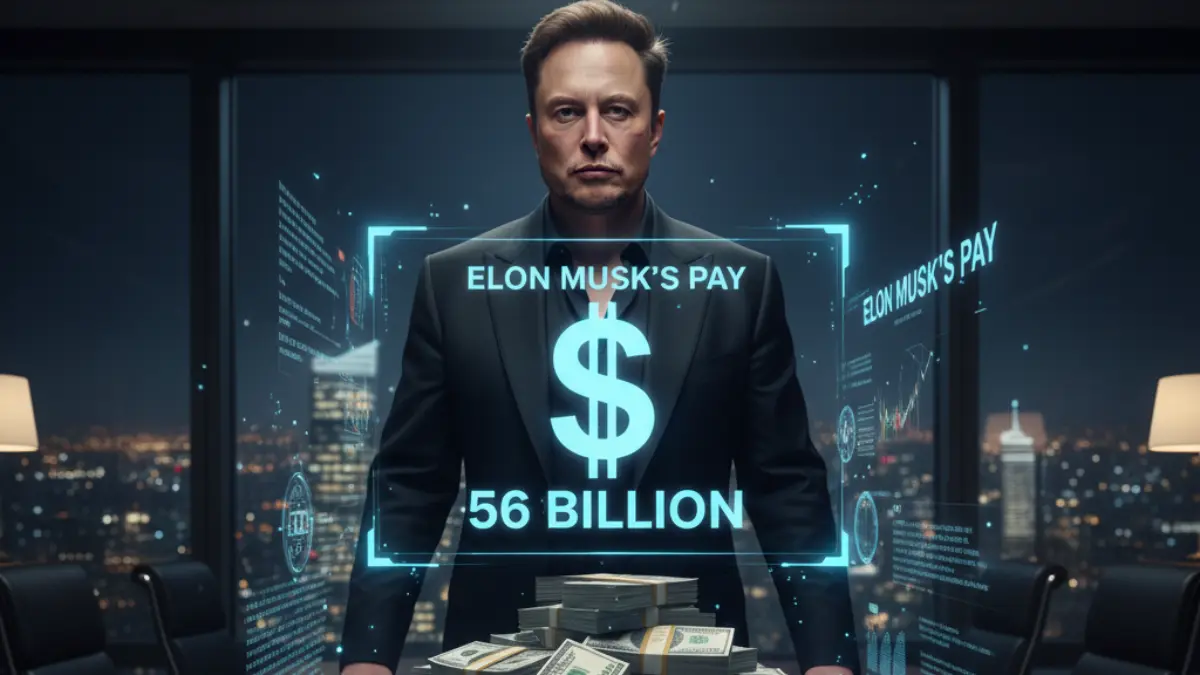
Elon Musk’s $56 Billion Pay Package Explained
Elon Musk: When you hear that one man could earn $56 billion from a single company, it sounds almost unreal — like something straight out of a sci-fi movie. But that’s exactly what happened with Elon Musk and Tesla, and it’s sending shockwaves across Wall Street and Silicon Valley alike.
What Exactly Is Musk’s Pay Package?
In 2018, Tesla approved a groundbreaking compensation plan for Elon Musk — one that didn’t include a traditional salary or bonus. Instead, it was entirely performance-based, tied to Tesla’s market value and financial milestones. If Tesla hit certain targets, Musk would receive massive stock options. If it failed, he’d get nothing.
How It Became the Biggest Deal in Corporate History
This wasn’t just any pay plan — it was the largest ever awarded to a CEO in the history of corporate America. At the time, many called it “crazy,” but Tesla investors believed in Musk’s vision. Fast forward a few years, and Tesla not only met but crushed those milestones, propelling Musk’s theoretical payout to a jaw-dropping $56 billion.
The Origins of the Controversial Compensation Plan
Tesla’s Bold 2018 Pay Structure
Back in 2018, Tesla was still viewed as a risky bet. Electric cars were niche, profitability was uncertain, and critics doubted Musk’s ability to deliver. That’s why Tesla’s board introduced this all-or-nothing pay package — a gamble that aligned Musk’s rewards with shareholder success.
The Performance Milestones Musk Had to Hit
To earn the full payout, Musk had to:
- Increase Tesla’s market cap from $59 billion to $650 billion.
- Hit 12 operational and financial milestones.
- Maintain profitability over time.
Spoiler alert: he did it.
Why Tesla Board Members Backed It
Tesla’s board argued that without Musk’s drive, innovation, and relentless vision, Tesla wouldn’t be where it is. They believed the plan was fair — Musk only wins if shareholders win.
The Legal Battle That Followed
Shareholder Lawsuit Against the Pay Package
Not everyone saw it that way. A group of Tesla shareholders filed a lawsuit, calling the package “excessive” and “unfair.” They claimed Musk wielded too much influence over Tesla’s board and that the approval process wasn’t truly independent.
Delaware Court’s Shocking Ruling
In early 2024, a Delaware judge made headlines by voiding Musk’s $56 billion pay package, ruling that it was “an unfathomable sum” approved by a board too loyal to him.
Why the Judge Called It “Excessive”
The court argued that even if Musk helped Tesla succeed, the pay plan lacked proper checks and balances — essentially saying no CEO should have that much power over their own compensation.
Tesla’s Response and Musk’s Next Move
Musk’s Reaction on X (Formerly Twitter)
Musk didn’t take the ruling lightly. He blasted Delaware’s corporate law system and posted,
“Never incorporate your company in Delaware.”
The Push to Move Tesla’s Incorporation from Delaware to Texas
Following the court’s decision, Musk hinted that Tesla may reincorporate in Texas, where its headquarters now reside — a move that could reshape corporate governance norms in America.
What Shareholders Are Saying
Some investors support Musk, citing his unmatched leadership and results. Others fear this level of power and wealth concentration could be dangerous in the long run.
Why This Pay Package Matters
It’s Not Just About Money – It’s About Power
Musk’s pay isn’t just compensation; it’s symbolic of his dominance in both the tech and auto industries. He’s not just a CEO — he’s a movement.
How It Reflects Musk’s Influence in Corporate America
Few leaders can sway markets with a single tweet. Musk can. This pay package reflects how much faith — or fear — investors have in his vision.
The “Cult of Musk” Effect on Markets
Whether it’s Tesla, SpaceX, or X, Musk’s personal brand often drives more attention than the companies themselves. That’s both his greatest asset and biggest risk.
Breaking Down the Numbers
How Musk’s Compensation Compares to Other CEOs
Let’s put it in perspective:
- Tim Cook (Apple): ~$100 million
- Sundar Pichai (Google): ~$226 million
- Elon Musk (Tesla): $56,000 million
That’s not a typo.
The Crazy Math Behind $56 Billion
Most of Musk’s compensation comes in the form of stock options, meaning he doesn’t get paid unless Tesla’s stock rises dramatically. And it did.
How Much of It Is Actually Cash?
None. Musk doesn’t draw a salary — his wealth is paper-based, tied to Tesla’s soaring valuation.
The Bigger Picture – Innovation vs. Inequality
Is Musk Worth That Much?
This is where opinions divide. Supporters say he revolutionized transportation and energy. Critics argue no one person should earn more than some nations’ GDPs.
The Debate: Visionary Genius or Corporate Overreach?
It’s the eternal Musk paradox — visionary innovator or corporate overlord? Depending on who you ask, he’s either the Einstein of our age or the poster child for corporate excess.
The Impact on Future Executive Pay Packages
Musk’s deal has already inspired similar high-risk, high-reward compensation structures. But after the Delaware ruling, companies may think twice before approving another one like it.
How Shareholders and Employees Feel
Tesla Investors Divided
Some see Musk’s leadership as irreplaceable. Others think Tesla’s success now depends on scaling responsibly, not taking billion-dollar risks.
Employee Perspectives from Inside Tesla
Inside Tesla, opinions vary. Many employees admire Musk’s brilliance, but some express frustration over long hours and intense pressure.
What This Means for Stock Prices
After the court ruling, Tesla shares wobbled — but history shows that whenever Musk faces a challenge, he tends to bounce back stronger.
The Future of Tesla Under Musk
Can Musk Keep Delivering Big Results?
That’s the billion (or 56 billion) dollar question. Tesla’s facing growing competition from BYD, Rivian, and legacy automakers like Ford and GM.
The Challenge of Balancing Innovation and Oversight
Musk’s genius thrives in chaos — but investors now want stability alongside innovation.
What Analysts Predict Next
Analysts believe Tesla will continue to dominate EV markets, but regulatory and governance pressures may force Musk to adapt his leadership style.
Conclusion – A Defining Moment in Corporate History
Elon Musk’s $56 billion pay package isn’t just a story about money. It’s a story about vision, risk, and the blurred lines between genius and greed.
Whether you see him as a modern-day Tony Stark or a corporate rule-breaker, one thing’s certain — no one can ignore him.
This saga will go down as one of the most defining moments in corporate governance — and we’re all witnesses.
FAQs
1. What makes Elon Musk’s pay package so controversial?
Because it’s the largest in history and challenges traditional corporate governance norms.
2. How does this deal affect Tesla’s future?
It could influence where Tesla incorporates, how it compensates executives, and how investors view its leadership.
3. Could this happen again at another company?
Unlikely, given the legal backlash — but Musk often sets trends that others later follow.
4. Did Musk actually receive all $56 billion?
No, much of it remains in stock options and is subject to ongoing legal and market conditions.
5. What’s next for Elon Musk and Tesla?
Expect Tesla to keep pushing boundaries — but also facing scrutiny like never before.